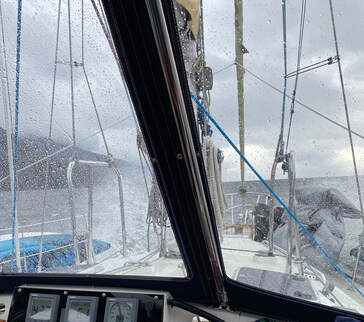
 There were no bears in the Tracy Arm Entrance Cove when we dropped anchor that evening. The bears knew: a storm was coming. We were blissed after our visit up Tracy Arm to see the Sawyer Glacier, and we thought that the storm traveling north in Stephens Passage had passed us by while we were protected within the high canyon walls of the fjord. But by one in the morning, Rapport strained on the anchor chain. We swung violently sideways. I didn’t look out the portholes. I pictured Lt. Dan tied to the mast with a fist to sky, and I curled deeper under the down comforter. I had no argument; but I too wanted peace, or to feel at peace with the wild. Twelve hours earlier, we had calm waters within the narrow inlet of the Tracy Arm. We motored through silted-grey waters of 268’ depth to arrive two-hundred yards from the terminus. We anchored and dropped the dingy to navigate the passage choked with ice. Ice of varying colors and sizes amassed: some blue like the sky, most a dingy white, some clear as glass, and some chunks of grey moraine. The mass parted and we wove around the larger bergs to creep to the terminus. Fifty yards from us, seals lay on ice floats, and eyed us warily. The glacier issued low rumbles. A large piece broke from the top, tumbled down the face, and dropped with little splash into the ocean. We heard the ice sever and tumble; we watched it roll and then sink, and we waited for the ocean swell to lift our boat. In the presence of the towering face, it’s hard to believe it’s shrinking. Sitting in the dingy surrounded by ice and pelted by rain, I was chilled through my life vest, heavy rain jacket, parka, and four layers. It’s rained all week, and hovered in the upper 40s, not the average September temperatures of upper 50s.When we returned to Rapport, an iceberg rested alongside her. We pushed off with boat hooks. The danger is that the iceberg would damage her hull. We pulled anchor, motored along the calm waters of the fjord, to spend the night in the sheltered entrance cove. [excerpts from essay: Glacial Speed
20 Comments
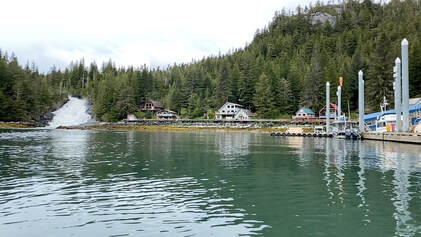 We arrive in the tiny hamlet of Baranof at eight the evening of May 25th. All that comprises the “town” are a half-dozen homes, a dock, a bath house, and a path uphill to the springs. The focal point here is the hot springs. We tie up, put our dock fee in the box, and take to the hill path. Along the boardwalk portion of the trail, we pass bear prints in soft mud and broken stems of skunk cabbage. Despite the invisible company, we have the hot springs to ourselves. Aboard Rapport, there's no shortage of hot water, especially when underway, but that does not diminish the delight to float in hot, sulphur pools beside a steep, turbulent waterfall. I am sore: my arms unaccustomed to so much paddling. I am stiff: my body unused to so much sitting. Next morning, we clamor into the kayaks to explore Warm Spring Bay. Last winter, Kent changed how the dingy is attached so that it’s easier to raise and lower. As a result, it’s awkward to move under and onto the transom. Then the maneuverings into the kayak are heightened by a fear of tipping into the cold water. The heave out is more the challenge—underscoring my aging, damaged body. I plop into the kayak and then upon returning, reach across the transom deck, grab the ladder, and pull myself aboard. Both offer a total lack of grace, generally accompanied by swearing. This morning’s mission is to explore the salt lagoon. The connecting channel from bay to lagoon completely empties at low tide. On first pass our timing is off, and the channel is all rocks, but when we return twenty minutes later, we are able to walk, pulling our kayaks over a skim of water, and paddle around the lagoon noting the many sea urchin varieties and the thick smell of salt and seaweed in this stagnant water. Tide is rising and within twenty minutes there is enough to (sort of) paddle out. Oh, the power of the rising tide! It’s all of a knee deep but rushing in like a fire hose. I struggle: paddle in place, tire, stop paddling, and then shoot back into the lagoon. And oh, my Impatience! I could wait until it’s deeper, but we want to get out now! Stuck: maybe this is the moment of breath, of acceptance. When riding to a fence on my very bold horse Tiny, there was that moment a stride out, when I had to train myself to take a breath, to allow him his moment for take-off, and not chase him to the base, as my instinct desired. It was my moment of acceptance that he had picked his spot and asking for speed was only my nervous energy unnecessary. Stuck allows space to gather energy, trust the process, and allow the forward movement that is to follow. Although asking for help is good too. On the bank, Kent takes my painter, and drags me forward a step and I then get a paddle deep enough to propel me through the gap and into Warm Spring Bay. In thirty minutes, the tide will allow easier passage. But I want to spend those thirty minutes in the bath house, and then we want to catch the tide on Rapport. Leaving Baranof, we reconnect with the outside world and messages flood into my phone. Susanna has texted that her DC apartment was broken into the previous night. A thief entered their basement window with crowbar, pulled the TV off the wall, took all car keys on the counter, wrapped the TV in a blanket from the sofa, exited the apartment, went to the closest responding car, and drove off. This was hours ago—while I was soaking in a hot tub, or possibly paddling upstream. I have just texted to ask if she was home at the time when my phone rings: “weren’t you concerned,” she said. In the deep inlets of Alaska, we reside within a quiet to which I am unaccustomed. Even hunkered down in Vermont, there is constant communication. While I celebrate this presence in the absence of interruptions, this text jolts. Yes, I am concerned. This age of iphones have brought the luxury and security of knowing I can talk text at any time to check-in with my children. Alaska interrupts that security. Susanna was in fact in her bedroom and in the depth of sleep at the time, and she thought the noise outside her room was her roommate returning home. Her car, parked further away, was not the one stolen. The police have come, the search for the roommate’s car and the thief is on, and later the car will be found totaled. We talk. I breathe; she is safe--and competent. Also surfacing: a photo from Graham showing our porch table set with plates of steak and salad, and full-bloom lilac trees in the background. I am missing the lilacs. It’s like missing fall foliage. They were barely buds when I left. I begin to chafe at absence, concerns, seasons, discontent, age, mission. All questions swirl like a shallow tide that I cannot gain traction in order to propel forward: What is this boat to me? When do I want to be on the boat? When do I want to be home in Vermont? What about horses and riding seasons? Dogs on the boat? What do I do on the boat? What am I missing? What am I gaining? Paddling upstream in less than a foot of water, I accept how apt the metaphor: stuck as how to integrate and move forward home and boat lives. In a few days, we fly out of Juneau to meet Susanna in Colorado Springs for her college graduation—one year later, on Covid time. A graduation ceremony, to remind us we are indeed moving forward. That even delayed plans are both forward movement and worth honoring. With the delay and passage of time, it would be easy to dismiss this event as no longer relevant but instead I am reminded plans don’t operate on the schedule we want, but its own timeline. And ceremony provides ritual to move forward and to celebrate together, to mark time passed, and accomplishments achieved. As I packed up what was to stay on board, I handed Kent my Xtratuf boots knowing he would want them very clean in order to go below deck. As I emerged from the cabin, my bag in hand, I met him in the galley with a forlorn look, “I thought it would float.” He had dropped my boot into the ocean when washing it and it had sunk to the bottom of Auke Bay. A ll is not lost, just a boot. We float on, not stuck but maybe requiring a little help and timing to move forward to destination unknown. 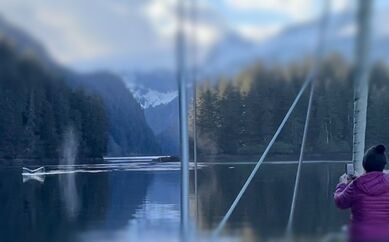 As we enter Red Bluff Bay, a great humpback dives below Rapport. The tail rises above the water and the scale of the mammal astonishes me. We pass by each other, boat by whale, tail by bow, as if this is all normal, that we just went left-hand to left-hand to a whale as easily as I pass another horse in the warmup ring before the show jumping round. Have a good round! And we pass through a narrow and go deeper into the length of the bay. We are the only boat, the only ones here, as if this was how the land was encountered when expeditions met Alaska hundreds of years ago. Is this how presumption begins? We motor along: enter a cove, leave a strait, cross the sound, thwarted in the arm, anchor in a chuck, travel the narrows, sail the channel. The landscape etymology may impart a velocity, a depth, a current. These names involve the distinctions that mark the land. As indigenous named places for their qualities, explorers named them for themselves. And a balance tipped from partnering with the land, to place the self before all else. Red Bluff is one of the few places on the map we have visited thus far that is named for features and not a person. Red cliff walls rise. We pass the remains of an old cannery on the shore. At the head of this bay, we see the terminus of river, and a low marshy area. The estuary, where river meets sea, is where we meet bears. It’s too early for the salmon to run, but bears graze the saltwater grasses. We drop anchor near shore, and a movement catches the eye, and two small cubs scamper up the rocks and disappear behind the thick veil of pine boughs. Where is their mother? Further in the distance, upon the grassy shore, a large mama grizzly grazes with her two year-old cubs. Kent and I get in the kayaks and head over to watch. Mountains thick with pines rise around us. We paddle towards the bears. At the mouth of the river is a log jam of entire pines tangled with smaller deciduous trees, and branches. The river, engorged with spring melt and rainstorms, carried these trees, roots and all, down the river to collect at the terminus. Loud and steep streams run down the mountains and surge into the sea. We paddle in close and can’t hear each other over the sound. They have the power to scour an entire pine tree off the mountain, propel it off the land, and plant it in the sea. I kayak over trees and approach one lone pine standing, an upright ghostly figure, the bark rotted off, branches gleaned, but the roots have been ballast and it stands with just a few feet of top protruding from the surface. I paddle around this standing pine as if there might be a whole forest subsumed below me, but it’s only a lone tree, revealing the power of the forces that shape the landscape. I have been reading Unchartered about a woman’s passage from empty nest to sailor, as she travels the Canadian inland passage in search of the spirit bear. I too am an empty-nester traveling the inland passage. What am I searching for as we go? To investigate this question, I interviewed my mother over the winter months. She has made many trips to Alaska. Each trip led to another destination. First a sailing trip in Prince William Sound before the spill. Then a land conservation conference in Anchorage. Then the Arctic Circle where she was picked up at the “airport” by a Gwich’in elder on her ATV with a rain barrel strapped behind her. Later, she met an Eyak warrior working to heal the waters, revive the fisheries, and save the forests south of the Prince William Sound. She rafted the Copper River and each night they ate the salmon from the river. She met a former bush pilot who staked a claim in 1952 at Denali and started a tourist camp which prompted her to start a conservation group to save that wilderness. (In June, we will visit Denali and the Copper River in the company of my mother.) My mother’s work took her to sit on a porch in Moose, WY with Mardy Murie, the naturalist, author, and conservationist who led the work to pass the Wilderness Act. My mother lives her life in the patriarchy of New England, but in Alaska, she fell into the company of elder women. “They are there for the place to live a lifestyle they can’t live elsewhere.” Standing with these famous women changed her. “And they don’t forget you.” My mother didn’t have a plan when she encountered Alaska. And unlike the unchartered woman, I am not seeking a seldom seen bear. As part of her quest, she struggled to be an equal partner to her husband aboard their sailboat. I tell Kent, “I am not going to be a partner to you sailing.” I haven’t filled my time practicing knots or reading charts or perusing the manual on docking strategies. “I am a passenger.” As if that’s not obvious. “Good,” he replies, “there’s room for only one captain.” But I don’t want to be a passenger simply sailing through this landscape. I do want a mission without presumption. I want to make a difference. And to learn from those that have missioned and travelled before me. For what are we without a mission, without humanity, without each other? As we move through this landscape, I gather more questions than answers, but maybe there is a lesson in the not knowing. As I see more and question more (there’s a quest in that word), I get to know the stories of people I meet here. I learn how their mission evolved through experiences. During those early months of the pandemic, Kent and I walked in the woods with our dogs. He asked: where do you see yourself in five years, then three years. He asked me for a vision of myself. Clearly, he saw himself on a sailboat, and he wanted to know when. “Now,” I had told him, because my staff was trapped, I could be free to leave and join him on a sailboat in Alaska. It was not a vision, but timing. And now we are anchored in Red Bluff Bay. A whale dove below our vessel. Bears stand on the beach. I watch these animals on their mission for their survival. Without other boats, without other passengers, and without cell service, without distractions, I am present. And I am diminutive. The great humpback tail, the mama bear on her hind legs sniffing the air, the cliff walls climbing 2000 feet, the ocean depths greater than the aged pine tree, the rush and power of waterfall, the mountains: all dwarf me. They reduce my scale and right-size me within this environment. Barry Lopez tells us, To speak with such intimacy of the features of a place is to belong to that place. To know the difference between the chuck and the cove, between the strait and the narrow, I can begin to know this place by studying her features. The whale and the bear restore my calm and my curiosity. To note the three-beat rhythm of the movement of the whale—spout, back, tail—settles me in a pace. To sniff the air like the mama bear heightens my senses. To feel the mist of the waterfall is to understand its power to shift a landscape. A small motor boat arrives in the mid-morning, and anchors beside us. They lower their kayak to the sea, and the couple climbs into their tandem kayak. “Thank goodness we don’t have that,” I say to Kent. He nods. It’s good to be able to paddle away from each other. They sidle up to our hull and ask about bears. The bears have moved invisibly into the land. We laze in the mid-day sun drinking coffee, reading books. In the late afternoon, we pull up anchor. They inquire why we leave so late in the day. We are moving with the tide, and there is after all, hours of daylight. We head to out of the bay, catching sight again of the two small cubs scrambling the rocks, and furthering my concern they are motherless, and set a course to Warm Springs Bay. This is Alaska and the sun won’t set for several hours. 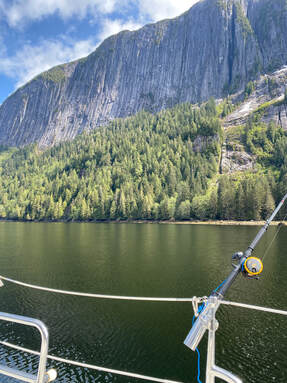 In May, I returned to Rapport. Kent had transited through Canada in April, and I flew to meet him in Ketchikan. Alaska! Cliff walls, silted-oceans, snow-capped mountains: all of enormous heights and depths. I can do nothing but stare, maybe absorbing the scale of the scenery, and possibly allowing the pandemic grief to diminish its hold. Day one aboard, I slept soundly after 16 hours of traveling in middle seats and shuffling through packed airports of the lessening pandemic. After six months, I expected to slip back into boat life. Below deck, at the new table in the main cabin with a cup of tea, I gaze at a grey world outside the portholes, spotted with raindrops. I didn’t expect the space to feel tight, but perhaps after leaving Vermont when spring was shouting—daffodils in bloom, horses back in work, pastures greening up, leaves unfurling—it’s hard to rein in my energy. I am not quite sure what to do with myself while Kent fritters with electronics, checks oil, stows covers, and prepares to cast off. The day before we wandered the single street of Ketchikan, the fifth largest city in Alaska with a population of 8,050. First stop, I went to Rainforest Cannabis, located conveniently at the top of the dock ramp, to prepare for whatever rough seas may lie ahead aboard Rapport. Kent had ditched my stock in Seattle before he went through Canadian waters. I was not going to sea unequipped. Luckily for him, I could resupply. The following day, we cast off from Ketchikan and set course for Misty Fjords. As we pull away, I coiled lines and pulled in the fenders. The day was grey with calm waters, a head wind, and cool skies. Ketchikan (possible Tlingit definition is the Thundering of Eagle wings) and all her eagles slipped away. By 8pm, we dropped anchor in Punchbowl Cove, finding a manageable 50-foot shallows. I didn’t realize until we were deep within the tall rock walls that we would have no service. I had not alerted our children nor work that I would be completely out of reach for who knows how long. They do know I am on a sailboat in Alaska. Light for another hour, we took the dingy ashore to scout out the trailhead up the falls to Punchbowl Lake. After a day in the cockpit, the steep hike up the falls enticed, and so scouting transformed to hiking. We walked over rotting log walkways across small ravines, through rock-bordered trenches within the moss-covered forest floor, between dense moss-coated trees and in thirty minutes arrived at the glacial lake. We scanned the lake and then scrambled down the trail through the darkening dense canopy to get to the beach while still light. We carried the dingy over rocks exposed by falling tide to motor back to Rapport and eat dinner at dusk, at 9:30. Without cell service, and simply sitting, I am completely present to the place. On shore a rock moves, and so reveals itself to be a brown bear eating grass. We kayak in to watch. Behind us, Rapport within this fjord looks so small, but it’s hard to capture the scale of the place. To have it stripped down the land itself, and to feel the scale of it so starkly, we lose all proportion. Cruise ships have not yet resumed. We were alone in this fjord; we had left civilization and entered a wilderness. Leaving my job and animals and adult children doesn’t feel quite natural. I am out of my element. I can feel the wind blow and change direction; I can see the tide rise and feel the current shift. But I don’t know what to do with this information. I grab my book and tell Kent I am going to sit on the uphill side. “Windward,” he says. I watch the bow rotate and pivot. “Look at how the bow rolls,” I say. “Yaw,” he replies. There is a language for everything, and I know none of it. Kent goes below and tells me to stay the course. The water has a light ripple. The sun shines, and a few wispy clouds scatter the sky. The walls climb away from me. The pine boughs hanging over on the water’s edge are shorn even by the sea tide. An eagle flies over head. We leave behind the bear digging in the sand. Sitting behind the helm and Kent below deck, I am glad the ocean is 946 feet deep, the walls are steep, and the sea is flat. I’ll manage. In four days, I have read Ordinary Wolves, and Rock Water Wild, and If you Lived Here, I would Know your Name, and From the Bright Edge of the World. All Alaskan stories, all touching on white imperialism. When I left Vermont, the legislature had just passed the bill apologizing for the Eugenics law. This place so big and wild and holds the same tragedies of our white invasion on native land. A year after the pandemic and social protests, I see this place differently than I might have a year ago when I would have been only focused on the land and not the people, like us, moving over it. Scanning the rocky horizon, I think of our impact on climate, on race, on the wild, and contemplate our role within a diversity of race and wildlife. I consider the uncertainty of how to right our course. Leaving the fjords, we bypass an impenetrable ice field, and enter the straits on a course to Wrangell. There’s a good wind from the east so Kent unfurls the jib. Rapport tips, and so do I. Nausea creeps in, catching me like cell phone service and civilization gone, unaware. After several days on the boat, I didn’t anticipate a slight heel would accelerate my heart rate. It’s mild, and with ginger tea, I manage. Dall porpoises cross our bow and pop around us like popcorn. Because of their distinctive coloring we see them below and anticipate their surfacing. As we pull into a slip in Wrangell, Kent tells me the tide is coming in, and therefore he is going to change his angle of approach. He tells me all this information as if I can learn this. He comes in steeply, and I stand with a fender and monitor our distance to the big yacht with potted flowers in their windows. We glide into the spot between the yacht and the corner of the dock. No fender required. The next day we pull out of the slip, and we have to swing the bow around to get out of the corner of the dock we are in. I am at the helm, the tide is coming in. “It will catch the bow and help us swing,” he says. Kent walks the dock with the bow line. I turn the helm, using a slight bow thruster. The bow begins her swing 180 degrees away from the dock and into the channel. Still on the dock, Kent puts one foot on the deck and to push as Rapport separates from land. His other foot planted on the dock, he strains across the increasing divide. In our twenties, I would have no doubt of him leaping on deck, but now thirty years later my heart races and my breath tight in my chest and I hope his on-board foot doesn’t slip, or his pushing leg doesn’t cramp, that he doesn’t fall into the water, and I would be alone on Rapport and trying to figure out how to jam the boat back into that spot on the dock without hitting the giant yacht with potted plants. I have, of course, retained nothing from his lessons. I exhale. Afterall, while the water is cold at 55 degrees, he could swim. Or I can throw him a line.  Shake down: a testing under operating conditions of something new (such as a ship) for possible faults and defects and for familiarizing the operators with it. High winds, head winds, becalmed, beam reach, close haul: we experienced a range of sailing conditions. Despite that initial recommendation that we leave the boat yard and head straight to a dock and tie up, we went to sea and spent eleven days roaming the San Juan Islands. The transmission powered through head-on 50-knot gusts and rough waters without a stutter. The only rattle was when idling while pulling up anchor. A moment when Kent, upon leaving our first anchorage, dead calm morning and Kent muttered dead calmly, “oh by the way, the anchor chain battery may be dead.” As I prepared to literally haul the anchor, I watched the chain slowly recoil into its foc’sle chain locker as we rattled backwards, then we hoisted sail, and left Roche Harbor. Hoist the mainsail, unfurl the jib, set the halyard brake: we got a feel for Rapport and tested her systems. Remember the blistering bottom paint? Remember the water running down the mast into the main cabin in high winds? Remember me being left alone in the cockpit so he could go below and radio the harbormaster? Remember the shit spray? (I do.) We learned the holding tank is not 40 gallons but 25, and an electric head continually running water diminished that smaller than expected capacity to brimming full. All the motions of our days roaming the islands had a cause and effect that led to the revised list: forward head, anchor chain, transmission, bottom paint, VHF in cockpit, mast boot. (Oh, this is only a partial list.) With a boat, I would expect it to work—not a process. When stuff stutters, Kent doesn’t see it as failures, but as a conversation. This boat isn’t a moment, but a long-term commitment. The discovery is part of what makes it engaging. Shakedown: a thorough search of a person or place. In training my horse, I work to understand motivations and abilities and forge a training partnership based on how the mind and body of the horse tick. It’s a commitment, an on-going process, and it’s trial and error. I understand the questions I want to ask, and I may not quickly understand the replies, but I gain a bit with each conversation. The discovery is part of what makes it engaging. In engaging with the shakedown, I learned the following about myself:
Above all, I have no clue what’s going on. On our return to LaConnor, we had to navigate the ominous Deception Pass. We had been under sail the whole day with a good wind and traveling at 8-9 knots all day, tacking in Rosario Straits, and making good time. We were going to hit Deception Pass with an incoming tide, and then motor through Swinomish Channel to the LaConner marina ahead of schedule. “How lucky!” I exclaimed, as if the wind gods were on our side, blessing us with tides. I got a stunned look from Kent, and a dark shadow passed over his face. “Not lucky!” I recanted, “great planning!” I revised. He was always up hours before the rest of us, with charts, looking at the course, the depths and tides, the weather, and telling us a specific time to pull up anchor. Although really, the tide gods were on my side because favorable conditions didn’t occur before 9am. Shakedown: a process or period of adjustment We are just beginning. We test the boat, but we test ourselves, individually and together. Kent tests his skills both mechanical and navigational. I test my ability to coexist on a boat, to remain even-keeled, and my ability to learn. We have completed the shakedown cruise, for me, every cruise may be a shakedown. 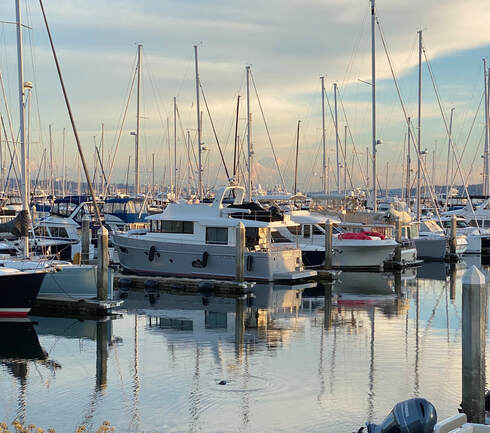 Mount Rainier visible through the masts in the distance, and seal visible swimming in the foreground. Rapport tied up at Elliott Bay Marina for a few days in Seattle while we made wintering over arrangements. (Great bike path around Elliott Bay to Seattle!) 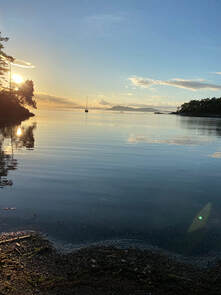 Becalmed, we drifted by current and not by sail power. The sepia-toned water ruffled by mild breeze and gliding seals. The sun was bright and the landscape hazy. We left Roche Harbor after a day of hiding from bad weather, unwinding from the rough travel of the previous day, and set sail on a new, calm day. Hallelujah! We sailed the channel between Johns Island and Orcas Island. To the west, on Johns Island, we imagined the tents, boats, and busy camp activity when Susanna was a counselor there several years ago. We looked east to Mt. Constitution where we had stood a few days before on the summit. In that direction, the sun was directly in our eyes. The landscape blurred, trees indistinguishable from each other, not from our speed, but from the glare of the sun. My first day out of the protection of the canopy, I sat basking on the foredeck. Our sails fluttered. We drifted along at 2 knots. Seals swam past us; we moved that slow. Warming sun, hazy shoreline, metallic sea, drifting seals: we entered a slippery, dreamy state where magic can happen. Something unusual might surface. Instead of losing myself to my book, I scanned the water and watched the seals. I heard a breath. I turned the direction of the sound. Then there was a spout of water, the crest of a whale, and a tail breaking the surface. I shrieked like a delighted child. A Humpback we later learn, named Stitch. They had been hunted to near extinction, to almost a memory, but in recent years have experienced a rebound. Four hours later, we arrived in Echo Bay on Sucia Island. A day absent of any motor. Three other boats had already moored. We choose a spot in the remaining light of day and removed from the other boats. We grabbed a mooring, dropped the dingy, and motored in as the sun dipped behind the trees of the island. We walked across the narrow neck to the western shore of Sucia. Over Shallow Bay, the sky lit up orange, streaked with narrow slivers of dark clouds. Day slipped to night, and in the dreamy twilight, the ocean refracted the golden hue. The sun sank over Vancouver Island, and thoughts of my dad surfaced. Twice I have been to Vancouver Island, both visits with my father, both by boat. First, on a family trip at age nine, we motored into Genoa Bay aboard the Cadrew. The story of my father as a child on a dairy farm on a Canadian island came to light. I always thought he was only the businessman before me, so this departure to a farm! On an island! In Canada! was somewhat startling. The currents of his mother’s quest for peace eddied here in this bay, for a time. My father was born in London in 1939. When Dunkirk fell, children were removed from the city. The forces of war ripped the family apart. Their staunch nanny—a toddler and an infant strapped to her—climbed the ladder, led by my father’s four-year sister, to board the US Washington. Eventually, they arrived outside Boston to live with their grandparents. His Austrian-American father joined the RAF and after over 130 missions he was shot down and killed off the coast of France. Five years later, their mother arrived, newly remarried, reclaimed her children, and took them to find peace on an island. She had married a Canadian Air Force pilot, a member of her husband’s RAF squadron—also a dairy farmer. And for a few years, this man created an experience of a normal family. My father always appreciated that. We watched my dad shake hands with his former stepfather, this man newly materialized to our personal history. When we returned eighteen years later on Star Rover, the farm stood empty—absent of the belted Galway cows, the stepfather, and even the farmhouse. It had burned down years ago. We rowed ashore and stepped over the broken fences. We walked past the crumpling barn, through the overgrown fields, up a hill to Sorenson’s rock, so named for the old farmhand. By the rock, Dad pointed across the bay, past Star Rover, to the town of Duncan: “that’s where we rowed to tutor’s house. Every morning we got out of the boat and waded ashore. Then mother decided we weren’t learning anything and sent us biking to the school on the other side of the island.” Walking down the hill, he chuckled, “That’s where Polly the plow horse ran off with my brother. He bounced all over until he finally fell off.” His mother, after a few years of her children biking eleven miles to school and using their wits to grab ahold of passing logging trucks to climb the hills to arrive two hours late each day, discovered that she wasn’t a good dairy farmer wife, not well-suited for life on an island, and perhaps limiting her children’s bright futures, took them on a summer vacation to her parents and never returned to Vancouver. After our stop in Genoa Bay, Star Rover sailed north into the Gulf islands. My father so at ease on a boat. How did he manage to bend his 6’7” frame into the bunk aboard? He fit easily behind the helm. I picture him settled off to the side a bit, one hand on helm, his face softened to smile, staring up the mainsail in his white sailor hat. His peace gave me courage to ask him questions. I wanted to know how he felt when his brother had returned to reclaim the family estate in Austria and he stayed in Boston, with no property to inherit, to make his own way. “Did you feel ripped off I wanted to know?” I mean, from my twenty-five-year old perspective, it seemed like he had a bad deal. As if his brother, caught in currents of the family history, passed him by, and my father was becalmed in Boston. “I didn’t have the confidence,” he said. I couldn’t imagine this but realize now how confidence comes so slowly, even when you’re barely moving and only the current carries you. And of course, he didn’t drift idly, he harnessed his power, built success, not only for himself and us, but also his civic involvements. On Sucia Island, we continued our walk. The sky was lit by the memory of the sun. We stumbled a bit on the forest trail, a well-trod single track that hugged the island perimeter. So close to Vancouver Island, only a narrow channel divided us, but I couldn’t touch it, like I can no longer touch my father. Before I left to fly to Seattle two weeks ago, I stopped to see my mom. “Take some of his ashes with you,” she said. “Please spread them in Genoa Bay. He would like that.” “We can’t cross into Canadian waters.” I said. “Next summer.” This fall I can only stare at this island of his childhood. My memories rise like the tide; my father, he’s here, caught in the currents of a history ripping through my present. My dad was so at ease on a boat. He wasn’t a man that brought his worries home from work, or the problems with healthcare and the Boston Public school system that he was committed to find solutions for. But he wore them. He was a big man and could carry much. I don’t know how he found comfort on Star Rover. Was it the distance from his work? Was it the absence of interruptions and communications? Was it sleep afforded by the rocking of the boat? Was it the magic that can descend when you slow your speed down to match the tide, hoist a sail, and take charts and wind as your only direction? We completed our small loop and returned to the stony edge of Echo Bay. We carried the dingy to the falling tide and pushed off into the still waters, to return to Rapport, a silhouette in the night sky. Kent and I sat on deck for a few hours, watching the final twilight dim, and then fell into the deep sleep of another night aboard, arising to another day to chart our next course. The sun is bright and the landscape hazy. The water ruffled and sepia-toned. We drift by current. Islands linger. Sails flutter. Be calmed. 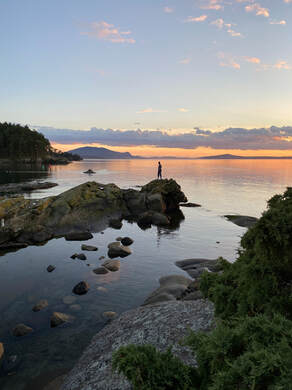 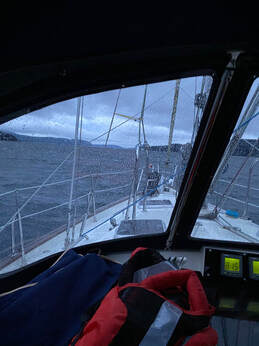 The wind woke me at 1am. Not a gentle rocking conducive to sleep but an infrequent jarring that triggered alert. By three am, tired of being tossed by Rapport tugging on her mooring, I turned on a light and worked. Kent was reading. Coffee was brewed. My anxiety brewed but I envisioned that sunrise would bring a dead calm, and a safe passage to a more protected harbor. When we checked in with the harbormaster earlier that day, he said they had begun hauling docks because the intensity of the waves do so much damage at this time in the season. I didn’t take this for what it perhaps was: a warning. He had also said, “the resort is closed.” Not realizing that all the buildings around us comprised only a resort and not a small fishing village, I responded, “and the store is closed too?” “Closed means closed,” he said. Now, as the boat swung on the mooring line and heeled and I was dumped to the other side of the berth, I realized this was not a safe harbor. This was exposure. I thought of waves crashing over the docks and gangways behind us. Excerpt from essay: Tides of Hope 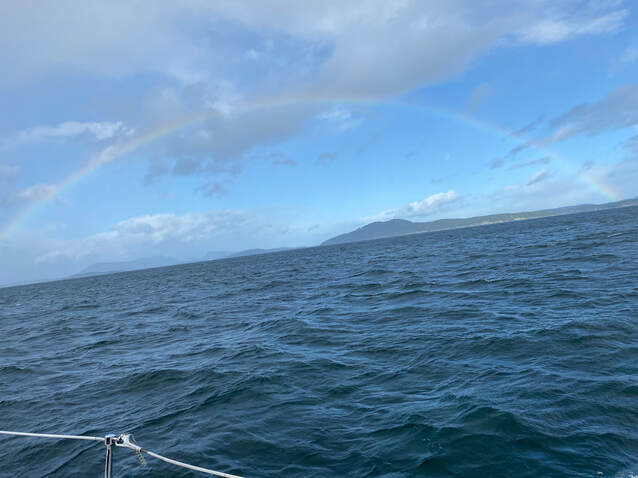 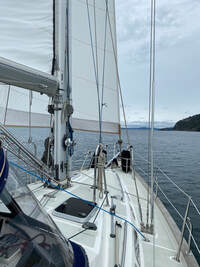 Day One: Today, I was sprayed with shit. Yes, people poop. Welcome to the shit show. We spent the night our first night aboard Rapport in the La Conner Marina, around the point from the boatyard. After lowering her into the water, the mechanics checked systems and discovered that the reason the propeller had a “funny” noise was due to a transmission issue. Heading out to sea and the San Juan’s with an under-powered transmission was not advisable. The recommendation: motor to the marina, winter over, and get the transmission rebuilt. As we motored out of the boat yard, instead of heading to the marina, Kent headed out to sea. We each took a turn at the helm, letting log storage, breakers, Goat Island and Hope Island slip by and turning at the channel to Deception Pass. Kent pronounced the transmission good enough to travel. Sylvia and Connor cheered and bumped their hiking trip. We returned to the La Connor marina to begin to chart courses. The next morning, we ran our final errands, filled our water tank, and decided to empty the holding tank while we had the opportunity. Sylvia stood at the switch. The hose stretched across the dock to Kent at the outlet on Rapport. The pull of the hose threatened the suction on the outlet. “Hold the hose,” Kent said to me. I picked it up to relieve the tension. He affixed the hose to the outlet. “Okay,” he called to Sylvia who flipped the switch. Over the noise he mutters, “I have never done this before,” as the power blows the hose off the boat and shit sprays at me. More startling was the cold hose. With a bottle of Dawn, and Connor manning the hose, we washed my clothes on me. It’ wasn't not a lot but when it comes to people poop sprayed down your side, not a lot is more than enough. Day Two: Now I remember, it’s not the seasickness that’s my problem, it’s my fear. We sailed peacefully through Deception Pass and entered Rosario Strait. We unfurled the jib, attached the halyard, and raised the mainsail—all from within the cockpit. The sky was grey. The sea was grey. The wind was 20 knots on the beam, and we were sailing at a good clip of 8 knots. No sounds but the ocean. Not feeling the wind under the protection of the dodger—with all the systems there is little cause to leave and head out on deck. There are more lines than I remember, and brakes and buttons for auto-winches and reefing. I may have learned a little then, but I know nothing now. And it’s not just the language of sailing that is unfamiliar, it’s the motion. The wind bellows 30 knots, the boat heels, and I am consumed in panic. I fear the motion of the boat in the water, the way some people fear the motion of the horse. I am able to release control on the horse therefore it stands to reason I can do this on the sea as well. But not on this day. A blast of wind and the boat tips wildly. I lean across the cockpit to the rail. Sylvia tips her face into the wind. Kent assists Connor at the helm to turn a bit into the wind. The boat levels slightly. I ease my grip and move to a high point on the boat. I see the delight on Sylvia and Connor, and this is Connor’s first time on any boat. That this does not come naturally does make me wonder if it’s possible I can allow this motion. Can I truly inhabit this sailboat? Really, I am scared shitless. “Maybe Mom you should take an edible, and we can lash you the mast, and you can listen to John Denver on headphones, and then you will love the whole sea experience.” Because it’s not possible to listen to John Denver, and not feel as if you are in some Pollyanna universe. It could work. It’s been exactly thirty years since I truly inhabited a boat. So long ago I don’t remember lines and wind directions, but close enough to have an imprint. I recall the placement of things: silk blouses in the foc’sle closet waiting for the next job interview in my post-college life; my stacks of shoes: heels for navy dinners, sneakers for running, Tevas for the beach; my desktop computer for resumes and letters sat on the dining room table. I remember the top-down fridge and the labeling the tops of cans so I could find them stacked in the cupboard. Here on Rapport, there is plenty of storage, but we have to structure the space, find the best movement. We stow food and trash bags and glasses and plates and learn the flow of the space. We bought a straw basket to hang for fruit. We discover the sink really heats up underway so it’s good storage for the still-partially full coffee press. Or I think, a pie. Everyone is on board with the pie idea: anchor at day’s end and eat warm pie. We settle into our habits on this boat: eat, sleep, sail, reside completely on board. Day Three: Wind is 30-40 knots today. Kent decides that for the long-term success of his wife remaining on board that Rapport remain in the harbor in Anacortes. The sun shines, the wind blows, and we wander about town, and purchase another down layer. And I think I am already failing: We should really be at sea. It’s days like this that people have sailboats and we are in safe harbor. I have not found my sea legs, nor sea heart nor mind. Sylvia and Connor are at ease. Kent is totally in his element. And I’d rather be in the mountains. I embrace the lessons from the horse: I can expand my comfort zone. Turns out that skydiving reference was an apt one. I have fear to confront and there’s no mind-changing at sea. I have to commit but it’s more than the commitment, because it’s more than mental. I want to do more than inhabit this space physically. Skydiving I could get through, and I was able to experience moments of joy, in the absence of control. I have to turn myself over to something larger than myself: something I am capable to do with skis, and on a horse, but the sea adds a new element. At the helm, I begin to sense the ever-changing contact with the sea and the wind, much like contact with reins and leg to the horse. Be quiet within, and allow that conversation. Tomorrow, we head out in lesser wind and a lot of rain. We will put up the sails and hunker down under the canopy. I am going to put on my poop shirt, find my sea legs, have heart, and let go of the rail. 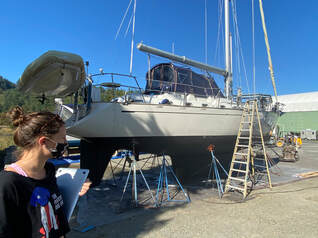 I pushed off my departure a few days. (Does it appear that I am stalling?) During the boat inspection, it was discovered that the paint, newly-applied prior to listing, had blistered. Rapport went back to the yard to be sanded and repainted. As planned, Kent flew to Los Angeles, met with Sylvia at her boyfriend Connor’s home, and the three of them drove to Seattle. They settled into an Air BNB to await my Friday arrival and occupied their days with some 18-mile hikes. Kent visited Rapport, did an electronics walkthrough with the previous owner, and waited for the paint to dry—and then, it blistered, again. She sits, out of water, in the boat yard. Meanwhile back on the farm, I had ‘the list’ to complete before my now Monday departure. I ticked through my items: cutting and freezing Brussel sprouts (a first), putting outside furniture into basement crawl space, clearing my mail pile, and laundry, laundry, laundry. It turns out when the children left home to return to college and move to new city for job, they left their dirty laundry behind. By Friday, the house was tidy, and work was steadily proceeding in others’ capable hands. Over the weekend, I relished the order, and the season. With dogs underfoot, I travelled on trails thick with orange, yellow, and brown leaves. I rode my horses. I considered the blistering paint. I watched a video clip on twitter of the Orcas attacking a sailboat. I had to stop watching the swells and bobbing whales because I started feeling seasick. I could stay another couple days. Delay is a deep breath, a pause waiting for something to happen. A moment to re-evaluate. Delay is a void, a space waiting to be filled. When Kent was in the Navy, delay was a loss of control. It was also a constant. Kent would leave home for two to four weeks at a time, then return home for a couple weeks. I would arrange my gallery work schedule to align with his two-weeks at home before he departed again for Fallon, for El Centro, or the carrier. Then his schedule would change. I would ask to adapt mine, but I was messing too much with everyone else’s schedule. In his few days home, we saw little of each other. The erratic schedule persisted on deployment. I planned to meet him for a month to travel in Australia. I gave notice at my job. I found a friend to take my dogs. Then came the uncertainty, mostly conveyed by letters, occasional phone call, but mostly the chain of command. The CO’s wife would call the phone tree: they are diverted to Somalia; Australia is delayed; Australia is cancelled. We will know in a week. Get a refundable ticket. It’s on. It’s off. I wanted certainty and commitment. I wanted a plan. I cancelled my trip; they did go to Australia. Uncertainly was the plan. When we got engaged in August, we set a May wedding date before his June deployment. My dream was a ceremony surrounded by lilacs. My experience told me this was risky. We moved the ceremony to November, a ceremony surrounded by falling leaves and early snowflakes, when family was already home during Thanksgiving. Pregnant, I think was on most people’s mind. Navy, was on mine. In April he shipped out. The cruise date moved up seven weeks due to the invasion of Kuwait. Delay then was anger. Delay was time spent re-reading Co-dependent No More. Delay then felt like I couldn’t make plans, my life on hold, or that I was insignificant. Delay now is reprieve. It’s opportunity. Delay is the place of transition. It is a moment of gathering before the shift unfurls; it is the lever between awareness and action. I like to rush transitions. I am impatient. I want to move forward, but the most stable changes occur more organically—as opposed to a flip-flop that might not last. Delay allows the assimilation, and the lasting change. Here is what I notice about how I operate: First I make a Commitment. I say yes to a goal, such as a big horse competition or moving the business to a new location. Or a sailboat. Then there is a step by step plan to achieve that goal. Forge a plan and forge ahead. Inevitably there is a setback, and what comes next is wild second guessing (possibly panic). This stage may derail the entire operation. Maybe I better stay put. Then there is re-evaluation to create more manageable expectations, followed by re-commitment, and finally persistence. I have been through these stages many times in pursuit of business goals and horse goals. Each time I set a course to move out of my comfort zone, I doubt, I persist, and I fret over a drawn-out timeline. Yet the time I said yes to skydiving, I went through these stages at warp speed. I met Sylvia in Christ Church, New Zealand to join her for a short interlude during her gap year. Again, like the sailboat, it was Sylvia’s dream to skydive. This was not my bucket list item; I don’t have a bucket list. Or if I do, I seem to be reverse engineering it. Commitment: We ascended in a small plane with a clear plastic tarp for a door. I had a flight cap and goggles gripped in my hands and a guide named Rudolf strapped to my back. An oxygen tube hung in front of me, “You won’t need that,” he said, barely audible over the sound of the engine. Second guessing: I looked at the lineup of travelers and guides pressed together. The medium age was closer to Sylvia, who was sitting across the aisle. She was smiling. Others glanced at me and I saw their thought-bubbles rise: if she can do it, so can I. There wasn’t anyone I could look to for assurance. I thought of my 82-year old neighbor back in Vermont who went skydiving when she turned 80. Panic: At 16,000 Rudolf tells me to take the oxygen. What?! I fumbled for the tube. I did my best to take little breaths and not hyperventilate, throw up, or pass out. Any one of those seemed very real options. Did I mention my fear of falling? Rudolf pats me on the head and tells me to put on my cap. We are last ones in the plane. Waiting. For what? he offered the chance to say no. Awareness: I had no idea how I was going to react. I had lost my nerve enough through riding accidents and recovered enough to know fear is an irrational experience. I could be fine. I could lose my shit. I’ve done both. Manage expectations: I don’t have to love skydiving, but I dohave to decide if I am going to go. And once I was out the door there would be no mind-changing. Re-commitment: My daughter was gone, out the door, falling through the sky, and that was a catalyst. Okay, I said. Rudi scooted and dropped me out the door so that he was sitting on the threshold and my legs were dangling in the sky. He put his hand on my forehead and pulled my head back. I pulled my legs back, under the fuselage, arced my back, and we fell. Persistence: We spun away from the plane. My eyes closed. I expected this moment of loss of control. And I expected to stabilize. Then, we were floating. The ground was not racing up to meet me. I looked over to the lake and to the hills and all that was Queenstown, New Zealand. I wasn’t screaming. I would have smiled but my lips were stuck to my gums. “The most dangerous thing on a boat is a schedule,” says Kent. “That’s when people leave the port in a storm.” I was increasingly reluctant to leave port at all. I am beginning to enjoy the delay. Delay is the moment of pure potential. I could love sailing. Or I could not. I could be wretchedly ill. Or not. I could feel the open spaces of the sea, or the claustrophobia of the cabin. I could feel the sea breeze or resent the tackiness of the salt air. I could roll with swells, or brace against. In the delay, I could imagine any outcome and I could envision only success. Commitment: I am now in an Air BNB on Reservation Road in the Swinomish Tribal Community, down the road from the boatyard. We have bought comforters, frying pan, glasses, pillows, measuring cups, socket wrenches, plates, silverware, groceries, rubber boots with fish-patterned lining, fishing line, and nets. We have been to the CBD dispensary. The man there perplexed by my request for edibles to combat sea-sicknesses. I bought three bags. Panic: “Wear a life jacket at all times,” is my mother’s response when I tell her I am going to combat sea sicknesses by getting high. In Walgreens, I purchase every available sea sickness remedy. I decide ‘drowsy’ could be a smart choice. Awareness: We can’t go to Juneau this fall because we cannot transit Canadian waters during the Pandemic. We change our course to sail in the San Juan Islands and return to Seattle. The boat is still out of the water, so we kayak. We revise and are not derailed. We manage our expectations. We cannot control the situation, but we can control our response to it. We adjust our course based on new information, and time. And this shakedown cruise does not have to define my whole future of sailing. I have to get the feel of life with a boat and this is all part of it. This is a journey after all—give it time. This afternoon we climbed ladders and loaded the boat with our purchases. We climbed down just as they were pulling out the scaffold. And they put her in the water. And there she floats. Tomorrow we set sail, at noon, when the tide is right for Deception Pass (which I mistakenly called Desperation Point). The delay is over. |